Best overall: resource-led outreach. Best for product-led coverage: editorial product outreach. Best for stores with existing recognition: unlinked brand mentions. The best link building strategies for ecommerce stores in 2026 match useful content or products with relevant publishers—not a monthly backlink quota.
- Resource-led outreach leads the best link building strategies for ecommerce stores because publishers need a reason to link.
- Linkible is an option for ecommerce brands seeking agency support across outreach, digital PR and niche edits.
- Use editorial product outreach for product-led coverage and unlinked mentions to reclaim existing recognition.
- Judge ecommerce backlinks by relevance, placement context and destination—not domain authority alone.
Why this matters
An ecommerce backlink campaign needs more than referring domains. It needs a clear connection between the publisher’s audience, the linked page and the products you sell. A relevant link to a useful buying guide serves a different purpose from an unrelated homepage placement.
In 2026, build your brief around that connection before choosing a tactic. Linkible offers link building and outreach services for ecommerce brands; evaluate the proposed publishers, outreach methods and reporting before commissioning a campaign.
Linkible is a fit for ecommerce brands seeking link building agency support rather than another SEO software subscription. The buying decision still depends on the campaign scope, not the agency label.
What makes the best ecommerce link building strategies?
Use these criteria to compare the approaches below:
- Audience relevance: The publisher covers subjects your customers actually research.
- Editorial reason: The page earns its place through useful information, a relevant product or a credible contribution.
- Destination fit: The linked page answers the reader’s question and supports your commercial priorities.
- Policy compliance: The method avoids manipulative link exchanges and paid links intended to pass ranking credit.
- Reporting clarity: You can inspect the source URL, target URL, anchor text, placement context and link attributes.
- Repeatability: Your team can keep supplying the assets, expertise or products the approach requires.
Ecommerce link building strategies at a glance
The order below prioritises practical fit for ecommerce stores, not a claim that every campaign should use every tactic.
| Strategy | Best for | Standout feature | Key limitation |
|---|---|---|---|
| Resource-led outreach | Stores with useful buying expertise | Gives publishers a reference worth citing | Requires a genuinely useful asset |
| Editorial product outreach | Products with a clear editorial use case | Connects products with relevant coverage | Coverage and links remain discretionary |
| Unlinked brand mentions | Stores already attracting attention | Starts with existing brand recognition | Depends on eligible mentions |
| Digital PR | Brands with original evidence | Builds a story around a reportable finding | Requires evidence and editorial timing |
| Expert guest contributions | Brands with specialist knowledge | Places expertise in relevant publications | Requires original editorial work |
| Broken-link outreach | Stores with strong replacement resources | Solves an existing reference problem | Close topical matches are difficult to find |
| Editorial niche edits | Stores with relevant existing resources | Adds context to an established article | Paid ranking-credit placements create risk |
1. Resource-led outreach: best for useful buying expertise
Resource-led outreach promotes a reference that helps publishers explain a topic. For ecommerce stores, suitable assets include material comparisons, compatibility guides, maintenance instructions and product-selection frameworks.
Start with a customer question that needs a substantive answer. A rewritten category description is not a linkable resource simply because it sits in a blog.
Resource-led outreach pros:
- Supports targeted outreach to closely related publishers.
- Gives editors a specific reason to cite your page.
- Creates content your own customers can also use.
Resource-led outreach cons:
- Requires research, editing and ongoing maintenance.
- Does not justify forcing a commercial anchor into an article.
Best for: Stores whose product knowledge can answer difficult buying questions.
Ask your agency to identify the resource’s intended readers and likely citation contexts before production. If the pitch cannot explain why another page needs the reference, improve the asset first.
Verdict: Buy resource-led outreach support when you can publish something worth referencing.
2. Editorial product outreach: best for product-led coverage
Editorial product outreach introduces relevant products to writers covering buying decisions, practical applications or category developments. The pitch should explain the product’s relevance to a specific article or audience.
For your 2026 campaign, separate editorial outreach from advertising. Providing a sample does not entitle your store to positive coverage, a particular anchor or a link that passes ranking credit.
Editorial product outreach pros:
- Connects your products with relevant editorial topics.
- Can direct readers to a useful product destination.
- Gives writers a concrete subject to assess.
Editorial product outreach cons:
- Writers control coverage and editorial conclusions.
- Samples and fulfilment require operational coordination.
Best for: Stores selling products with a demonstrable use case or meaningful distinction.
Check the publication’s editorial requirements before sending anything. Follow applicable disclosure rules, and qualify links where a commercial arrangement requires it.
Verdict: Buy editorial product outreach when product relevance—not a promised backlink—is the pitch.
3. Unlinked brand mentions: best for existing recognition
Unlinked mention outreach asks a publisher to add a useful reference where an article already mentions your store. It works from an existing editorial connection rather than introducing an unfamiliar subject.
Not every mention needs a link. Prioritise pages where readers would reasonably want to identify the business, inspect the referenced product or read the underlying resource.
Unlinked brand mention pros:
- Starts with an established connection to your brand.
- Makes the outreach request specific and easy to understand.
- Can reveal inaccurate references that need correction.
Unlinked brand mention cons:
- Provides little scope when eligible mentions are scarce.
- Publishers can decline even a relevant request.
Best for: Stores already mentioned in editorial coverage, reviews or industry discussions.
Request the most useful destination, not automatically the homepage. Avoid turning an existing brand mention into an exact-match commercial anchor.
Verdict: Buy a scoped mention-reclamation project before committing to ongoing delivery.
4. Digital PR: best for original evidence
Digital PR turns credible evidence into a story journalists can report. Ecommerce inputs can include properly analysed customer research, product-category data or documented findings from qualified specialists.
The story must stand independently of your sales message. Publish the methodology, explain the scope and distinguish observed findings from interpretation.
Digital PR pros:
- Gives journalists original material to reference.
- Can address questions beyond individual product pages.
- Creates an evidence asset for future outreach.
Digital PR cons:
- Requires defensible evidence and careful preparation.
- Coverage does not guarantee a linked mention.
Best for: Stores with original information that supports a genuine editorial story.
Linkible offers digital PR alongside outreach services. Ask how a proposed story connects to your category and how the underlying claims will be checked; a broad headline alone does not establish commercial relevance.
Verdict: Buy digital PR when the evidence is ready; wait when the concept depends on unsupported claims.
5. Expert guest contributions: best for specialist knowledge
Expert guest contributions place original advice in publications serving a relevant audience. Your contribution should solve a reader’s problem, not disguise a product description as an article.
For ecommerce, useful expertise can concern product selection, materials, care or category-specific purchasing mistakes. Choose a publication because the subject belongs there, not because it accepts submissions.
Expert guest contribution pros:
- Lets your specialists explain a topic in depth.
- Creates a clear connection between expertise and audience.
- Supports contextual references where editorially justified.
Expert guest contribution cons:
- Requires original writing and editorial revisions.
- Scaled, link-first guest posting can become manipulative.
Best for: Stores with credible specialists who can contribute practical knowledge.
Ask who writes the article, who verifies the claims and whether the publisher exercises editorial control. Reject proposals built around unrelated sites and prescribed keyword anchors.
Verdict: Buy expert contribution support when you can supply real expertise; skip generic article placements.
6. Broken-link outreach: best for replacement resources
Broken-link outreach identifies an unavailable reference and proposes a useful replacement. The replacement must fulfil the original reference’s purpose, not merely mention the same broad topic.
A detailed care guide can replace a missing care reference. A product listing is not an equivalent substitute for an independent explanation simply because both concern the same material.
Broken-link outreach pros:
- Gives the publisher a concrete maintenance issue to resolve.
- Encourages close matching between context and destination.
- Can reuse a resource you already maintain.
Broken-link outreach cons:
- Research can produce few genuinely suitable opportunities.
- A publisher can remove the reference instead of replacing it.
Best for: Stores with substantial educational resources and a tightly defined subject area.
Require your agency to show the broken reference, its surrounding context and the proposed replacement. That comparison matters more than the number of prospects discovered.
Verdict: Buy a limited research project first; expand only when the replacements genuinely fit.
7. Editorial niche edits: best for relevant existing resources
An editorial niche edit adds a useful reference to an existing article. The legitimate case is straightforward: your resource supplies information that improves the article for its readers.
The risky version sells ranking credit through paid insertions. Google’s spam policies identify buying or selling links for ranking purposes as link spam; paid links need appropriate qualification.
Editorial niche edit pros:
- Starts with an identifiable article and citation context.
- Lets you assess the surrounding content before outreach.
- Can connect an established resource with a relevant reference.
Editorial niche edit cons:
- Commercial placement arrangements require policy scrutiny.
- Irrelevant insertions add little value for readers.
Best for: Stores with resources that fill a specific gap in existing coverage.
Ask how opportunities are sourced and whether payment influences placement. An agency’s “white-hat” label does not replace checking the actual method and link attributes.
Verdict: Hold until the editorial reason and commercial arrangement are clear; skip paid ranking-credit placements.
How these strategies are ranked
This 2026 ranking uses the criteria above: relevance, editorial reason, destination fit, policy compliance, reporting and repeatability. It is a decision framework, not a measured performance comparison.
Resource-led outreach takes the default position because it begins with something a publisher can use. Mention reclamation moves higher when your store already has coverage; digital PR moves higher when you hold credible original evidence.
Turn the shortlist into an agency brief
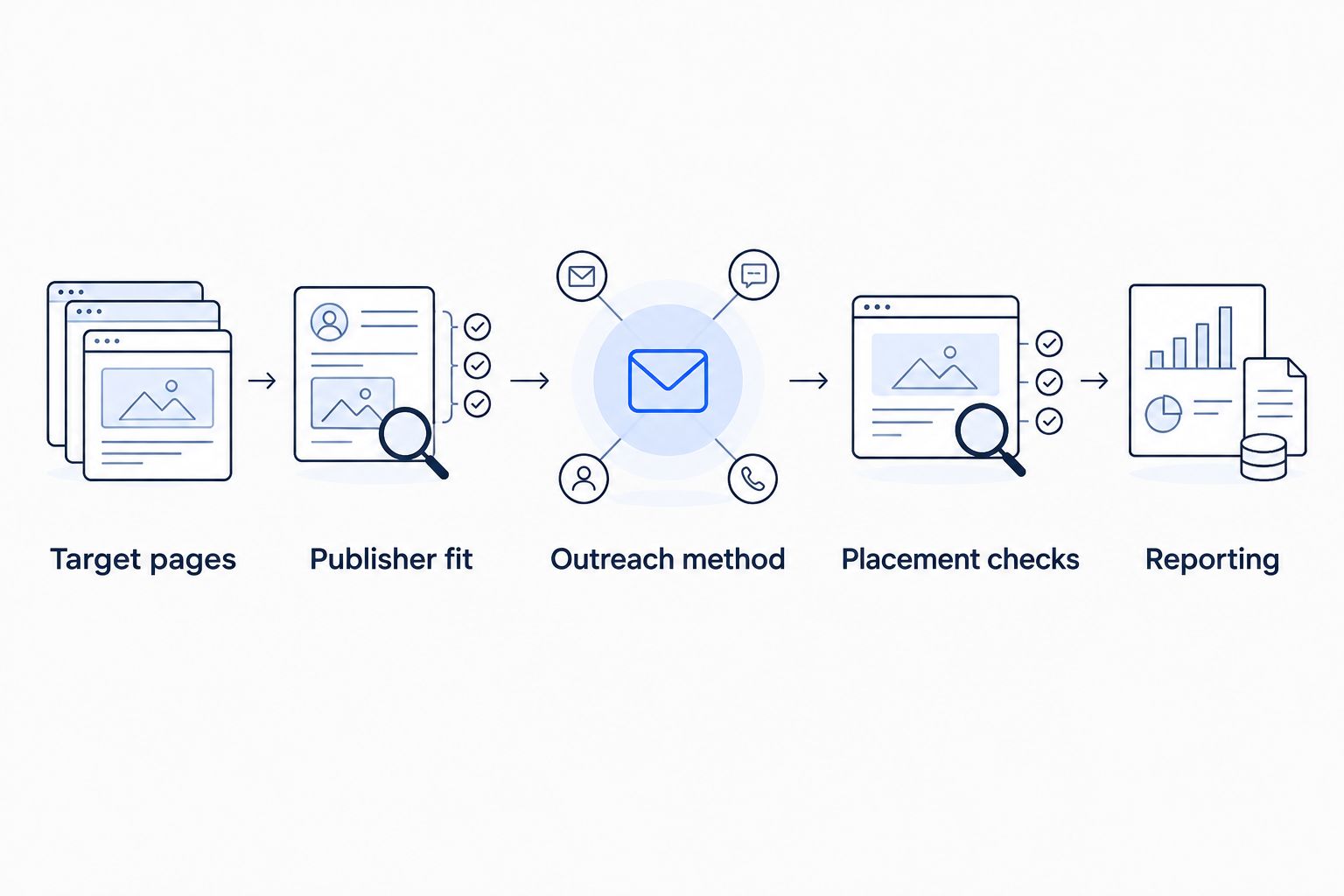
Before choosing a service, connect the strategy to specific pages and publishers. Use this sequence to turn a broad backlink request into an assessable scope:
- Target pages: Select 3 candidate pages and explain the customer need each page serves.
- Publisher fit: Request 5 candidate publishers with a written explanation of audience relevance.
- Outreach method: Confirm who researches prospects, writes pitches and handles responses.
- Placement checks: Agree how relevance, anchors, commercial arrangements and link attributes are assessed.
- Reporting: Request source URLs, destination URLs, placement context and status updates.
Those quantities are a starting brief, not performance benchmarks. A smaller, relevant shortlist beats a longer list your team cannot justify.
For a 2026 campaign, also agree on a 30-day reporting cadence. Review completed placements separately from outreach activity, and assess organic performance without attributing every ranking change to backlinks.
Which ecommerce link building strategy should you choose?
Choose resource-led outreach as the default when your store can publish useful buying expertise. Add product outreach for editorially relevant products and mention reclamation where coverage already exists.
Choose digital PR only when you can support the story with evidence. Treat guest contributions, broken-link outreach and niche edits as targeted approaches—not requirements to fill a package.
When comparing proposals, ask what the agency needs from your team. A plan that requires research, expert access or product coordination should state those dependencies before work begins.
FAQ
What's the best link building strategy for an ecommerce store in 2026?
Resource-led outreach is the default recommendation for ecommerce stores with useful buying expertise. It gives relevant publishers a clear reason to reference your content; product outreach and mention reclamation suit different starting points.
Should ecommerce backlinks point to products or buying guides?
The destination should match the editorial context. Product coverage can justify a product-page link, while an explanatory article usually needs a useful guide or reference.
Is digital PR better than guest posting for ecommerce?
Digital PR fits original evidence, while expert guest contributions fit specialist advice. Choose the method that matches what your store can credibly contribute rather than treating either as universally better.
Are paid niche edits safe for ecommerce SEO?
Paid niche edits intended to pass ranking credit conflict with Google's link spam policies. Check the commercial arrangement and required link qualification rather than relying on a seller's description.
How many backlinks does my ecommerce store need?
There is no universal backlink target for an ecommerce store. Set campaign scope around relevant pages, suitable publishers and defensible opportunities rather than a fixed monthly quantity.
What should an ecommerce link building agency report?
An agency should report source URLs, destination URLs, anchor text, placement context and link attributes. Keep outreach activity separate from completed placements so you can assess both clearly.
Can Linkible help with ecommerce link building?
Linkible offers ecommerce link building support through outreach, niche edits and digital PR services. Ask for a scope that explains publisher relevance, outreach methods, deliverables and reporting before choosing an approach.
One last thing
The destination page is part of the link building decision. Before approving outreach, check that the page still answers the promised question and has a clear next step for the reader. A relevant placement cannot fix a misleading destination.
To enquire about Linkible’s ecommerce link building services, start at the existing website. Bring your priority pages and ask which outreach approach fits them before requesting a placement quota.
Discuss your ecommerce link building
Bring your priority pages and ask about publisher relevance, outreach methods and reporting.