
Best overall: targeted editorial outreach. Best for original evidence: research-led digital PR. Best for lean teams: unlinked mention reclamation. These are the best link building strategies for SaaS companies in 2026 when your priority is relevant editorial links, not a larger backlink count.
- The best link building strategies for SaaS companies start with relevant publishers and useful destination pages.
- Targeted editorial outreach is the default; research-led digital PR suits teams with original evidence.
- Unlinked mention reclamation suits lean teams with existing brand coverage.
- Linkible offers SaaS link building through outreach, niche edits and digital PR.
Why this matters
A SaaS backlink campaign needs a commercial brief: which buyers you want to reach, which pages deserve attention, and why another publisher should reference them. A domain authority target alone does not answer those questions.
Linkible is a link building agency for SaaS teams seeking outreach, niche edits and digital PR. When you evaluate an agency, ask for evidence of publisher relevance, its outreach process and a sample placement report—not a ranking promise.
The strongest strategy depends on what you already have. Original research supports a different campaign from a useful product guide or an established brand with unlinked coverage.
What makes the best SaaS link building strategy in 2026?
Judge each strategy against these criteria before choosing a service:
- Audience relevance: Does the publisher reach the people who influence or buy your software?
- Editorial purpose: Does the proposed link help readers understand, verify or act on something?
- Destination quality: Does your target page deserve a reference without relying on the backlink itself?
- Execution requirements: Can your team supply the evidence, expertise and approvals the campaign needs?
- Placement transparency: Will the report show the live URL, destination, anchor text and link attributes?
- Policy fit: Does the method respect publisher rules and Google's link spam policies?
Relevance comes before a third-party authority score. Use authority metrics as supporting filters, then inspect the publication, article and proposed placement yourself.
SaaS link building strategies at a glance
| Strategy | Best for | Standout feature | Key limitation |
|---|---|---|---|
| Targeted editorial outreach | Repeatable publisher prospecting | Matches a useful resource to a specific editorial need | Depends on strong pages and relevant pitches |
| Research-led digital PR | Original evidence and industry coverage | Gives publishers findings they can cite | Requires defensible research |
| Expert source contributions | Founder and subject-matter expertise | Answers a journalist's specific question | Editors control inclusion and links |
| Contextual niche edits | Existing articles with a genuine reference gap | Adds a useful resource where it already fits | Paid ranking links create policy risk |
| Unlinked mention reclamation | Established brands with existing coverage | Starts with publishers already discussing the brand | Limited by existing mentions |
| Partner resource links | SaaS integration and ecosystem discovery | Connects users with relevant implementation resources | Requires genuine relationships and useful documentation |
1. Targeted editorial outreach: best for repeatable prospecting
Targeted editorial outreach matches your existing expertise or content to publishers whose readers need it. The work starts with a credible reason for the reference, not a request to insert a keyword-rich link.
For SaaS, useful destinations include technical explainers, original resources and detailed workflow guides. A sales page needs a clear editorial reason to earn a reference; being commercially important to you is not enough.
Targeted editorial outreach pros:
- Supports a defined audience and topic brief.
- Works with useful content you already own.
- Makes publisher suitability reviewable before outreach.
Targeted editorial outreach cons:
- Weak resources leave little reason for publishers to respond.
- Generic pitches miss the article's actual needs.
- Editorial acceptance remains outside your control.
Best for: SaaS teams with strong resources and a clear buyer profile.
Ask the provider to explain why each proposed publisher and destination belong together. A relevant domain with an unrelated article is still a poor match.
Verdict: Buy targeted editorial outreach as your default service when your destination pages are ready.
2. Research-led digital PR: best for original evidence
Research-led digital PR turns defensible findings into stories that journalists and industry publishers can reference. Suitable material includes original surveys, documented experiments and analysis of data you have permission to use.
The research must support the headline. Publish the methodology, explain the sample and distinguish observed results from interpretation before pitching the story.
Research-led digital PR pros:
- Gives publishers a specific source to cite.
- Creates an asset your sales and content teams can reference.
- Connects brand expertise with a defined industry question.
Research-led digital PR cons:
- Requires research, checking and stakeholder approval.
- A promotional finding is not automatically newsworthy.
- Coverage does not guarantee a backlink.
Best for: SaaS companies with original evidence and permission to publish it.
For your 2026 campaign, reject a research proposal that cannot explain its method before production starts. A provocative headline cannot repair a biased question or an unsupported conclusion.
Verdict: Buy research-led digital PR when the evidence is credible; hold when the story depends on unsupported claims.
3. Expert source contributions: best for specialist knowledge
Expert source contributions answer journalists' or publishers' requests for informed commentary. HARO-style outreach belongs here: the core requirement is a useful, attributable answer from someone qualified to give it.
A SaaS founder, engineer or functional lead should respond within their actual expertise. The agency's role needs clear boundaries around request selection, drafting, approval and attribution.
Expert source contribution pros:
- Uses knowledge your team already holds.
- Supports coverage around a specific area of expertise.
- Provides a practical route to editorial participation.
Expert source contribution cons:
- Requires timely access to the named expert.
- Publishers decide whether to include a response.
- An attributed contribution does not guarantee a link.
Best for: SaaS teams whose specialists can supply clear, original answers.
Ask whether the provider submits responses only after expert approval. Reject invented credentials, fabricated experience and commentary written as though an unavailable executive personally supplied it.
Verdict: Buy expert source outreach when your specialists can participate; skip submissions that misrepresent their experience.
4. Contextual niche edits: best for existing reference gaps
A contextual niche edit adds a reference to an existing article. A legitimate editorial request identifies missing information and offers a resource that materially helps the reader.
The method needs careful scrutiny. Google's link spam policies cover buying links for ranking purposes; paid placements should use appropriate link qualification, such as rel="sponsored" or nofollow.
Contextual niche edit pros:
- Starts from an article with an identifiable topic.
- Lets you inspect the surrounding context before making a request.
- Fits resources that resolve a specific gap in existing coverage.
Contextual niche edit cons:
- Placement catalogues can prioritise transactions over editorial value.
- Unrelated insertions weaken the reader's experience.
- Unqualified paid ranking links breach Google's policies.
Best for: SaaS teams with resources that genuinely improve an existing article.
Linkible offers niche edits, but evaluate every proposed placement on its own merits. Ask about compensation, publisher approval and link attributes rather than treating the service label as a quality guarantee.
Verdict: Hold until the provider explains the editorial rationale and any commercial arrangement; skip paid ranking-link schemes.
5. Unlinked mention reclamation: best for established brands
Unlinked mention reclamation identifies pages that already discuss your company or product and asks whether a reference link would help readers. It starts with an existing mention rather than a new content pitch.
Prioritise references where readers need a clear source, such as product explanations or coverage of your published research. Not every mention needs a link.
Unlinked mention reclamation pros:
- Builds on an existing editorial connection.
- Makes the reason for contacting the publisher straightforward.
- Requires no new research asset to begin.
Unlinked mention reclamation cons:
- Provides little scope for brands with limited coverage.
- Some mentions do not justify a clickable reference.
- Publishers remain free to decline the request.
Best for: SaaS companies with existing press, product or research mentions.
Check the context before sending a request. A copied directory entry, an unrelated brand with the same name or a critical discussion needs a different response from relevant product coverage.
Verdict: Buy a focused reclamation project when genuine mentions exist; skip it as the main strategy for an unknown brand.
6. Partner resource links: best for ecosystem discovery
Partner resource links connect users with documentation, implementation guides or integration resources across a genuine business relationship. The purpose is to help someone complete a task, not manufacture a reciprocal link exchange.
For SaaS, start with relationships that already exist. A technical resource explaining how connected products work together gives a partner a clearer reason to reference you than a generic homepage request.
Partner resource link pros:
- Aligns the reference with a real user workflow.
- Supports discovery within a relevant software ecosystem.
- Connects documentation work with partner marketing.
Partner resource link cons:
- Requires a genuine relationship and a useful destination.
- Depends on partner editorial and documentation policies.
- Scaled link exchanges create link spam risk.
Best for: SaaS companies with active integrations or implementation partners.
Ask your partnerships team where users encounter missing instructions. Solve that information gap first, then discuss whether a reference belongs in the partner's resources.
Verdict: Buy into useful partner documentation; skip reciprocal-link arrangements created only for SEO.
How the strategies are ranked
Targeted editorial outreach is the default because it begins with the central buying decision: whether a publisher has a genuine reason to reference your resource. The remaining strategies fit narrower starting conditions—original evidence, available experts, existing articles, established mentions or active partners.
This is a suitability ranking, not a promise that one tactic produces more links or better rankings. Choose the strategy your available assets can support.
Check the service before signing in 2026
Request 3 example placements, choose 1 priority page for the initial brief and agree a 30-day reporting cycle. These are practical scoping requirements, not performance benchmarks.
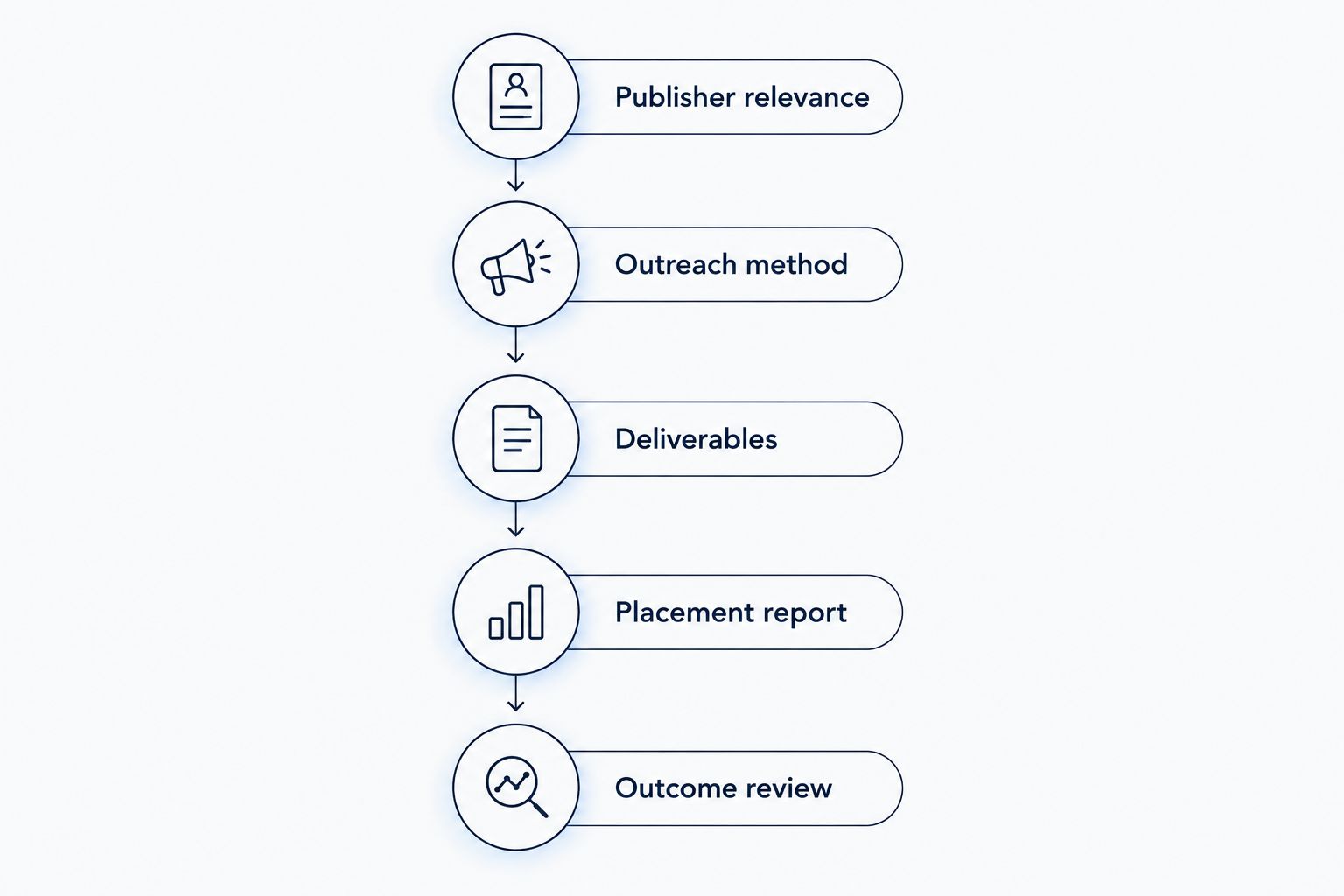
Use these checks to compare proposals:
- Publisher relevance: Ask which readers the publication serves and why they overlap with your buyers.
- Outreach method: Request an explanation of prospect selection, manual outreach and editorial approval.
- Deliverables: Separate prospecting, content creation, outreach and accepted placements in the scope.
- Placement report: Require live URLs, destination pages, anchor text and link attributes.
- Outcome review: Assess relevant referring domains and target-page search performance separately from activity totals.
A sample report should make an unsuitable placement easy to challenge. Screenshots of authority scores alone do not show whether a link belongs in the article.
Keep campaign measurement separate from promises. Report what was delivered, then examine changes in search visibility without claiming that every movement came from a particular backlink.
Which SaaS link building strategy should you choose?
Choose targeted editorial outreach unless a specific asset gives another strategy a clearer purpose. Use research-led digital PR for original findings, expert contributions for specialist commentary, and reclamation for existing coverage.
For a new 2026 brief, select the destination page before selecting the tactic. If the page offers little beyond a sales message, improve the resource or choose a more suitable destination before commissioning outreach.
FAQ
What's the best link building strategy for a SaaS company?
Targeted editorial outreach is the default recommendation for SaaS companies with useful resources and a defined audience. Choose publishers whose readers need the information on your destination page.
Is digital PR better than guest posting for SaaS?
Digital PR suits original findings, while editorial guest contributions suit useful expertise developed for a publisher's audience. Choose according to your assets and the publisher's editorial requirements, not a blanket preference for either format.
Should SaaS companies buy niche edit links?
Do not buy unqualified links intended to manipulate rankings. Evaluate contextual edits for genuine reader value, and require appropriate link qualification when a placement is paid.
How do I evaluate a SaaS link building agency?
Check publisher relevance, outreach methods, editorial controls and reporting before signing. Ask for example placements and a sample report showing destinations, anchor text and link attributes.
Can Linkible help with SaaS link building?
Linkible offers white-hat outreach, niche edits, digital PR and HARO link building for SaaS and other brands. Define your target audience, destination pages and reporting requirements when discussing the service.
How many backlinks does a SaaS company need?
There is no universal backlink target for SaaS companies. Set the scope around relevant publishers, useful destination pages and competitive search context rather than an arbitrary volume.
Does link building guarantee better rankings?
No link building strategy guarantees better rankings. Track accepted placements and target-page search performance separately, because content, technical issues and competing pages also affect search results.
One last thing
A publisher's refusal to link does not make the coverage worthless—and a live backlink does not make a placement useful. Keep editorial coverage and backlink delivery separate in your evaluation.
Before your next 2026 campaign, prepare a brief naming your buyer, priority page, relevant topics and unacceptable tactics. Take that brief to Linkible through its website enquiry route and ask how the proposed outreach and reporting will address each requirement.