
Best overall: resource-led outreach. Best for timely expertise: journalist commentary. Best starting point for local visibility: verified professional profiles. This 2026 guide ranks the best link building tactics for legal firms by relevance, editorial credibility and practical fit—not promised rankings.
- The best link building tactics for legal firms start with useful resources and relevant publisher outreach.
- Journalist commentary suits lawyers who can provide timely, attributable expertise within their jurisdiction.
- Verified professional profiles support local discovery; they do not replace editorial backlinks.
- Linkible offers link building services for legal firms; assess publisher relevance, outreach methods and reporting before choosing.
Why this matters
A backlink to a law firm should make sense to the person reading the referring page. A relevant legal explanation, professional listing or attributed expert comment creates that connection. An unrelated placement built around a search keyword does not.
Linkible provides white-hat outreach, niche edits, digital PR and HARO link building, including services for legal brands. Linkible is a link building agency for legal firms seeking external outreach support. Evaluate the proposed work against your practice areas, target jurisdictions and advertising obligations.
For your 2026 campaign, separate editorial opportunities from paid promotion. Google's link spam policies cover buying links that pass ranking credit; paid placements need appropriate link qualification. Calling a placement white-hat does not settle that question.
What makes the best legal link building tactics?
Use these criteria before choosing a tactic or approving a publisher:
- Audience relevance: The publication reaches people interested in the legal issue, location or professional subject.
- Editorial independence: The publisher controls what appears and can reject unsuitable contributions.
- Legal accuracy: A qualified reviewer checks jurisdiction, terminology and potentially misleading statements.
- Destination quality: The linked page answers the reader's next question rather than forcing an unrelated sales pitch.
- Placement transparency: Reports show the source page, destination, anchor text, link attributes and acquisition method.
Ask an agency for 3 sample placements with an explanation of why each publisher fits its client. Assess the context, not just the domain rating. A third-party authority score cannot establish whether a legal article is accurate or a placement complies with search policies.
Legal link building tactics at a glance
| Rank and tactic | Best for | Standout feature | Key limitation |
|---|---|---|---|
| 1. Resource-led outreach | Evergreen practice-area education | Gives publishers a useful reference to cite | Requires a strong resource and ongoing legal review |
| 2. Journalist commentary | Timely legal expertise | Connects named lawyers with editorial coverage | Coverage and links remain the journalist's decision |
| 3. Verified professional profiles | Local and professional discovery | Presents accurate credentials in an appropriate directory | Listing quality and link treatment vary |
| 4. Expert contributor articles | Specialist professional audiences | Explains a legal issue in depth | Demands writing time and genuine editorial scrutiny |
| 5. Unlinked mention reclamation | Firms already receiving coverage | Starts with an existing reference to the firm | Only works where relevant mentions exist |
| 6. Contextual niche edits | Existing articles needing a useful reference | Adds a source where readers already need clarification | Payment for ranking credit creates link spam risk |
These are campaign choices, not a requirement to use every method. Start with the tactic your firm can support with credible expertise and an appropriate destination page.
1. Resource-led outreach: best for evergreen legal education
Resource-led outreach promotes a useful legal guide, checklist or explainer to relevant publishers. The reference earns its place because it helps the publisher's readers understand a specific issue.
Choose a question your lawyers can answer clearly without giving personalised advice. Examples include a jurisdiction-specific explanation of a legal process or a document-preparation checklist. State the jurisdiction and have a qualified lawyer review the content before outreach begins.
Resource-led outreach pros:
- Gives outreach a substantive reason beyond requesting a backlink.
- Connects the referring article with a closely related destination.
- Creates an asset your firm controls and can update.
Resource-led outreach cons:
- Requires legal review and maintenance when the underlying rules change.
- Useful content alone does not guarantee publisher interest or links.
Best for: Firms with a clearly defined practice area and the capacity to publish reliable educational material.
For a 2026 campaign, name the reviewer and show when the resource was checked if your publishing process supports those details. Do not add a current date to unchanged, outdated advice.
Verdict — Buy: Prioritise resource-led outreach when your destination page genuinely helps the publisher's audience.
2. Journalist commentary: best for timely legal expertise
Journalist commentary connects a lawyer's expertise with a reporter's question. The contribution can explain a legal development, clarify terminology or identify a practical implication within the lawyer's area of competence.
Supply a direct answer, accurate credentials and any necessary jurisdictional limits. Do not turn a response into an advertisement or assume attribution will include a backlink.
Journalist commentary pros:
- Gives reporters an attributable professional source.
- Lets lawyers contribute without producing an entire article.
- Supports coverage around legal subjects the firm understands.
Journalist commentary cons:
- Requires responsive access to a suitable lawyer.
- Publication, wording and link inclusion remain outside the firm's control.
Best for: Firms with available spokespeople and a clear process for approving public comments.
Linkible lists digital PR and HARO link building among its services. When evaluating journalist outreach, ask which channels are currently used, who approves responses and how published coverage is recorded. Judge the process rather than the service label.
Verdict — Buy: Choose journalist commentary when your lawyers can provide useful, timely answers without compromising client confidentiality.
3. Verified professional profiles: best for local discovery
Professional profiles present your firm in directories maintained by relevant legal bodies, recognised professional organisations or credible local institutions. The immediate objective is an accurate, useful listing—not a keyword-heavy backlink.
Check eligibility before submitting anything. Use the firm's correct name, appropriate practice information and the same verified contact details used in its other public records.
Verified professional profile pros:
- Helps readers verify professional identity and credentials.
- Places the firm in a relevant discovery context.
- Provides a manageable foundation for checking public business information.
Verified professional profile cons:
- Some profiles do not include a link that passes ranking credit.
- Broad directory submissions can add irrelevant or poorly maintained listings.
Best for: Firms establishing their professional presence or correcting inconsistent public information.
Review your existing profiles in 2026 before commissioning additional submissions. Reject any proposal that substitutes a large directory count for named, eligible organisations. A profile should have a clear reason to exist beyond creating another referring domain.
Verdict — Buy: Complete relevant, eligible profiles; skip bulk directory packages built around volume alone.
4. Expert contributor articles: best for specialist audiences
Expert contributor articles explain a legal topic for a publication's established audience. A contribution to a relevant professional or trade publication should address that audience's actual questions, not repeat a generic practice-area landing page.
Agree on the subject and editorial requirements before drafting. The lawyer's expertise should carry the article; any link should help readers find a relevant source or understand the author's credentials.
Expert contributor article pros:
- Provides room for a detailed explanation of a specialised issue.
- Connects expertise with a defined professional readership.
- Allows an editorially appropriate citation within useful content.
Expert contributor article cons:
- Requires writing, legal review and revisions.
- Paid articles with links intended to pass ranking credit create policy risk.
Best for: Firms serving specialist sectors where audience knowledge matters more than broad exposure.
Ask who reads the publication and who edits submissions. Review its existing articles for subject consistency and credible authorship. A publication accepting unrelated promotional articles without meaningful review is not a strong editorial target.
Verdict — Buy: Commission contributor outreach when the publication's audience matches your legal expertise and editorial standards are clear.
5. Unlinked mention reclamation: best for existing coverage
Mention reclamation asks a publisher to add a useful link where an article already names your firm or lawyer. The request should help readers identify the source, verify credentials or find the material discussed.
Check the mention manually before contacting the editor. Confirm it refers to the correct firm and that the proposed destination matches the article's context.
Unlinked mention reclamation pros:
- Starts with a publisher that already considers the firm relevant.
- Avoids creating unnecessary new content solely for a placement.
- Makes the requested change straightforward to explain.
Unlinked mention reclamation cons:
- Offers little scope when the firm has no existing coverage.
- Publishers can decline links or apply attributes that limit ranking credit.
Best for: Firms whose lawyers, research or public comments already appear in relevant publications.
Do not request keyword-heavy anchors where the firm's name is the natural reference. A branded link is usually the clearer editorial choice when the article is identifying the firm itself.
Verdict — Buy: Reclaim genuinely useful references; skip requests where adding a link would not improve the article.
6. Contextual niche edits: best for improving existing references
A contextual niche edit adds or updates a link within an existing article. The defensible use case is a publisher improving an explanation with a genuinely useful reference—not selling ranking credit inside unrelated content.
Read the entire source article before approving a proposed edit. Check whether the destination supports the surrounding claim and whether the added wording changes the article's meaning.
Contextual niche edit pros:
- Can place a relevant reference beside an existing explanation.
- Avoids publishing another article when the topic is already covered.
- Allows direct inspection of the proposed source context.
Contextual niche edit cons:
- Paid links passing ranking credit conflict with Google's link spam policies.
- Existing articles can be outdated, misleading or unrelated despite attractive domain metrics.
Best for: Carefully reviewed editorial updates where a legal resource genuinely improves the source article.
Linkible offers niche edits alongside other link building services. Ask how publishers are selected, whether compensation is involved and how paid links are qualified. Require those answers before approving the placement.
Verdict — Hold: Approve contextual edits only after relevance, payment arrangements and link attributes are clear.
How the tactics are ranked
This 2026 ranking prioritises audience relevance, editorial independence, legal accuracy, destination quality and placement transparency. It is a decision framework, not a measured comparison of ranking gains.
Resource-led outreach comes first because it gives the publisher a useful citation and the firm a maintainable asset. Journalist commentary follows for firms with available expertise. Professional profiles provide a foundation; contributor articles, reclamation and niche edits depend more heavily on the specific opportunity.
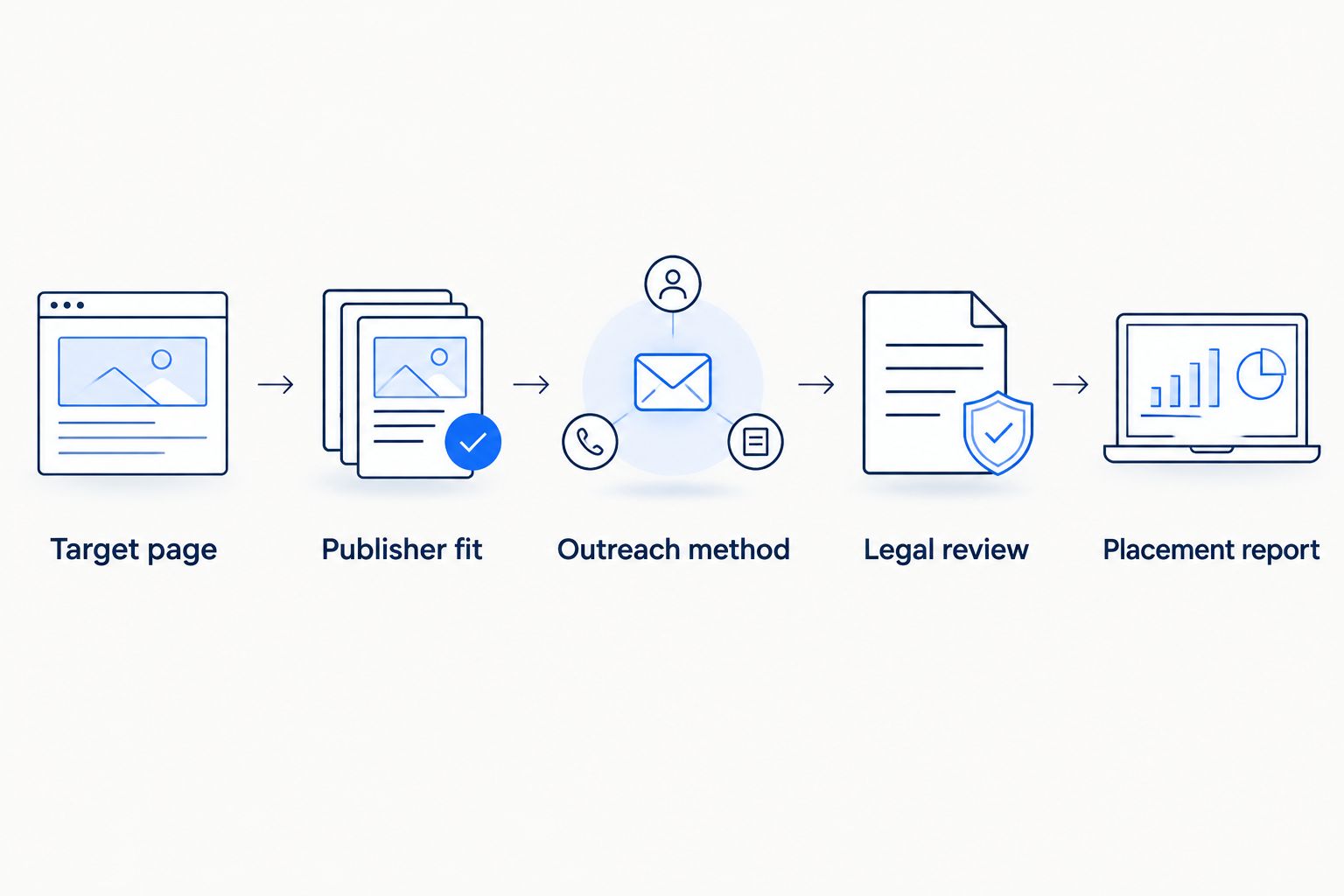
Check the campaign before approving outreach
Use 5 checks to evaluate the proposal. Apply them to each campaign rather than accepting a general assurance about quality.
- Target page: Identify 1 target page and the reader question it answers.
- Publisher fit: Explain the connection between the publisher, legal subject and intended audience.
- Outreach method: Confirm who contacts editors, what is offered and whether payment is involved.
- Legal review: Assign responsibility for checking claims, confidentiality and local advertising obligations.
- Placement report: Require the source URL, destination, anchor text, link attributes and publication status.
Manual outreach describes how contact happens; it does not prove that a publisher is relevant. Transparent reporting lets you inspect the actual work. Neither replaces legal review or compliance with search policies.
Which legal link building tactic should you choose?
Choose resource-led outreach as the default when your firm can publish and maintain a useful legal reference. Add journalist commentary when lawyers can respond promptly, and complete eligible professional profiles before paying for broad directory submissions.
If your firm already receives coverage, assess unlinked mentions before commissioning more content. Keep niche edits conditional on a documented editorial reason and a clear explanation of payment and link treatment.
For your 2026 brief, separate deliverables from outcomes. You can specify outreach activity, approval requirements and reporting fields. You cannot require an independent publisher to endorse your firm, publish a contribution or deliver a particular ranking.
FAQ
What are the best link building tactics for legal firms?
Resource-led outreach is the strongest starting point in this guide for firms able to maintain useful legal content. Journalist commentary, verified professional profiles and expert contributor articles suit different resources and audiences.
Should a law firm buy backlinks?
A law firm should not buy links intended to pass ranking credit. Google's link spam policies cover that practice; paid promotion needs appropriate link qualification and a separate assessment of its audience value.
Are legal directories good for link building?
Relevant professional directories are useful for accurate firm information and professional discovery. Check eligibility, editorial standards and link treatment rather than ordering bulk submissions.
Is journalist outreach better than guest posting for lawyers?
Journalist outreach suits timely expert comments, while contributor articles suit detailed explanations for a specialist audience. Choose according to lawyer availability, editorial requirements and the subject you can credibly address.
What should a legal link building report include?
A placement report should include the source URL, destination page, anchor text, link attributes and publication status. Ask for the acquisition method and an explanation of publisher relevance as well.
Can a link building agency guarantee rankings for a law firm?
An agency cannot control search rankings or independent editorial decisions. Evaluate defined deliverables, publisher standards and reporting instead of a promised position.
How should a law firm choose a link building agency?
Ask for relevant sample placements, a documented outreach method and clear approval responsibilities. Linkible offers link building services for legal brands; assess the proposed campaign against the same criteria used for any provider.
One last thing
The best destination is not automatically your main service page. If an article explains a legal process, a properly reviewed guide can be the more useful reference. Match the link to the reader's next question before choosing the anchor text.
Your next step: prepare a brief naming your practice area, jurisdiction, target page and legal reviewer. Take that brief to Linkible through its existing website enquiry route and request a proposal covering publisher relevance, manual outreach and placement reporting.